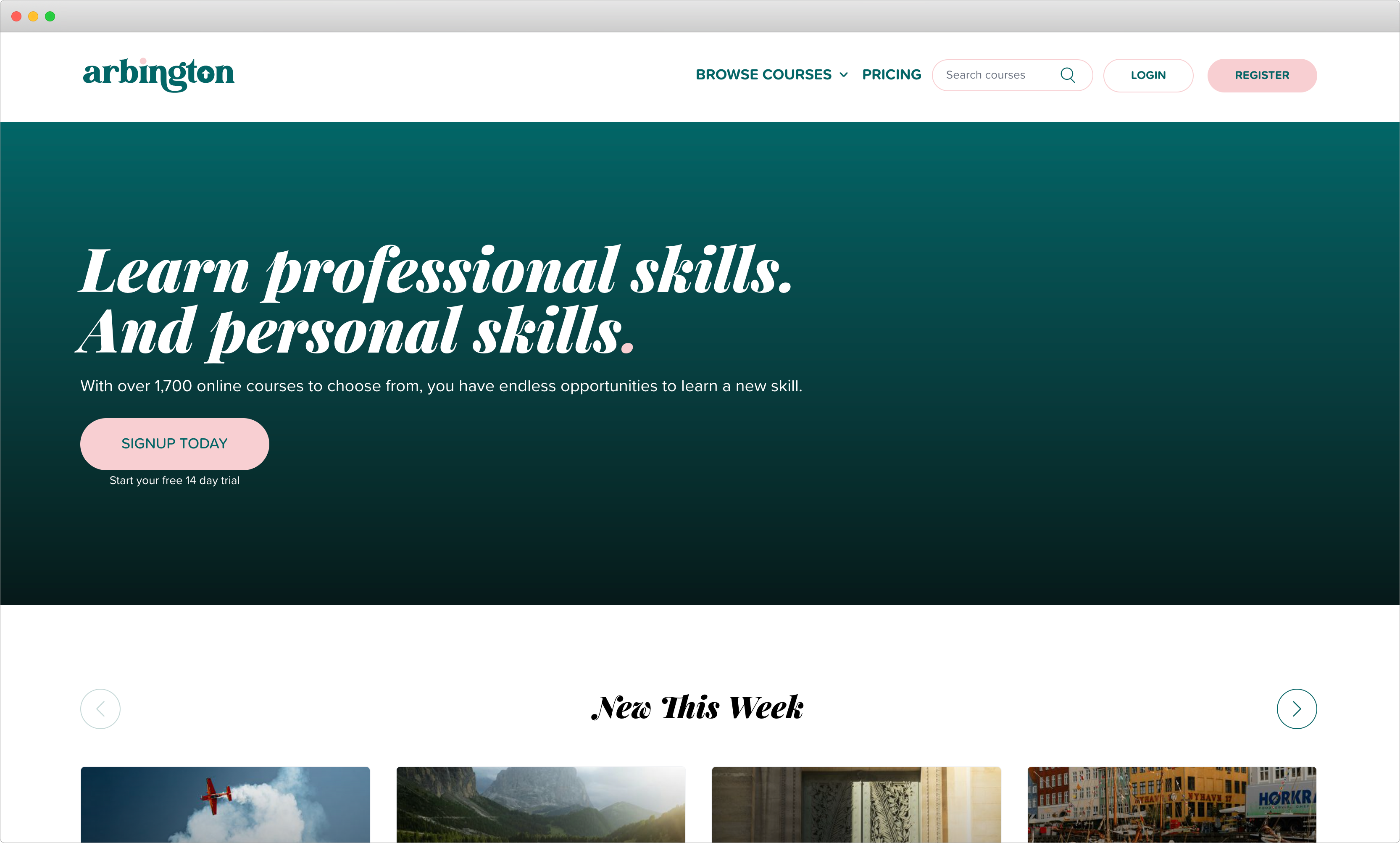
Arbington
A peer-to-peer learning marketplace: over 2,000 online courses and 20,000+ hours of streamable video, built from an idea to a real business, and ultimately closed when growth didn't clear the bar in time.
- Project type
- Startup
- Role
- Founder, CEO & original CTO
- Dates
- December 2020 – May 2022
- Status
- Closed
- Scale
- 2,000+ online courses, 20,000+ hours of streamable video
// 01 — The problem
Platforms take too much. Students want freedom, not 100 paywalls.
Platforms take too large a cut from the people actually creating the courses. Streaming video isn't that expensive, so most of that cut isn't paying for infrastructure, it's just margin.
On the other side, students don't want to buy a hundred separate courses from a hundred separate creators. They want the freedom to move from course to course, on their own schedule, without hitting a paywall every time they change their mind about what to learn next.
// 02 — My responsibilities
- → Original chief technologist and CEO — the job was to grow the company from idea to financial independence.
- → Grew the team and found a co-founder.
- → Decided what to build in-house versus what to contract out.
- → Took the company through Startup Edmonton's Propel incubator program.
// 03 — The approach
Build a two-sided marketplace by stocking the store with inventory first.
A marketplace with no courses can't attract students, and a marketplace with no students can't attract instructors. The plan was to break that chicken-and-egg problem by building up the catalog deliberately, before leaning on growth.
// 04 — Technical insights
Streaming sounds expensive. It doesn't have to be.
Cloudflare offers excellent streaming infrastructure for very little money, if you're willing to write a bit of extra code around it instead of reaching for an expensive managed video platform.
Payment method sprawl is a way to get nowhere
Supporting dozens of payment methods looks like good coverage. In practice it's mostly surface area: more edge cases, more reconciliation, more support tickets. Payout options made this worse, not better.
Horizontal scaling beat vertical scaling for this workload
The platform was mostly HTTP requests and task queues. That shape scales cheaply and predictably outward, rather than needing bigger and bigger machines.
Boring technology shipped faster
Django and Tailwind CSS made up nearly the entire stack. Avoiding anything bleeding-edge meant spending engineering time on the product instead of on the framework.
// 05 — Results
80% of the way to proof, on a one-year clock.
| Measure | Result |
|---|---|
| Team size | 4 |
| Investor interest | Real, but deliberately held off — an inkling that AI was coming turned out to be the right call, since peer-to-peer learning businesses are not in good shape as of 2026 |
| Content | Over 20,000 hours of streamable content, from instructors teaching nearly every skill on the planet |
| Subscribers | Hundreds, but growth wasn't fast enough |
| Growth deadline | One year from public launch to show strong growth, or shut down. The project reached about 80% of that bar — real progress, but not proof of accelerating growth |
// 06 — What I learned
Two-sided marketplaces are hard. Making something isn't the same as them coming.
Two-sided marketplaces are hard.
You're solving two different trust and incentive problems at once, for two different audiences, before either side has much reason to show up.
Just because you make it doesn't mean they'll come.
A real catalog and a working product are necessary. They are not sufficient.
Investor relations are a large key to success.
Capital isn't just runway — it's also validation, networks, and discipline that are hard to generate alone.
Bootstrap as long as you can.
Every month bootstrapped is a month of decisions made for the product and the users, not for a term sheet.
You can build too large, too fast.
Scope and headcount ahead of demand is its own kind of risk, not just a sign of ambition.
Know when to outsource versus build in-house.
Using ffmpeg to convert video into streamable pieces in-house cost more, in engineering time and reliability, than paying Cloudflare to ingest and stream the content instead.
Don't be the tech lead and the CEO at the same time.
Both jobs need full attention. Splitting focus between them means neither gets it.
Technology solves problems. Marketing brings the solution to the people who have them.
A better platform doesn't matter if the people with the problem never hear about it.
// Technology used
| Layer | Technology |
|---|---|
| Backend | Django |
| Infrastructure | Docker, Kubernetes, AWS (S3, EC2, and more) |
| Frontend | Tailwind CSS |
| Payments | Stripe, Braintree, PayPal |
| Video | Cloudflare Stream |